Google Cloud Platform
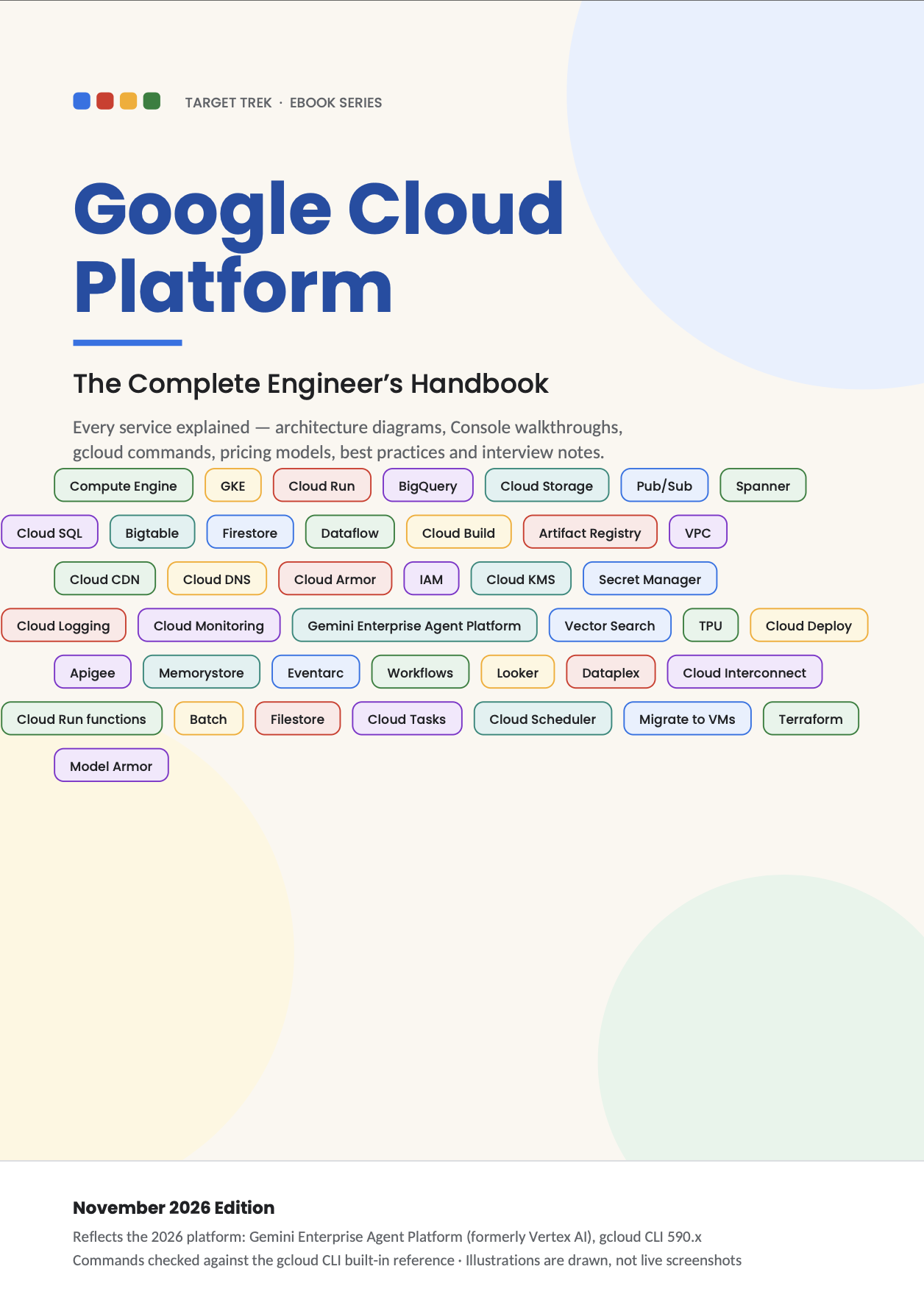
The complete Google Cloud handbook in 18 parts: global infrastructure, IAM and governance, Compute Engine, GKE, Cloud Run, serverless, Cloud Storage, databases (Cloud SQL, AlloyDB, Spanner, Bigtable, Firestore), BigQuery, Pub/Sub, Dataflow, VPC and load balancing, Cloud Armor, KMS, Secret Manager, Gemini Enterprise Agent Platform (formerly Vertex AI), DevOps, observability, FinOps, Apigee, migration, reference architectures, certifications and interview questions.
Price: ₹149 ₹399 · Digital PDF ebook · instant access after purchase
Frequently asked questions
What is the Google Cloud (GCP) Engineer's Handbook?
It is a Target Trek ebook in 18 parts plus appendices that explains Google Cloud from the ground up: global infrastructure, IAM, compute, containers, serverless, storage, databases, analytics, networking, security, AI, DevOps, observability, cost management, migration, reference architectures and career preparation.
What is inside every service chapter?
Each service chapter follows the same 12-part structure: an at-a-glance summary, what it is, when to use it and when not to, key concepts, an architecture diagram, a console walkthrough, gcloud commands, extra deep-dive sections, how you are billed, best practices, common pitfalls and interview and certification notes.
Which compute and container services are covered?
Compute Engine, instance templates and managed instance groups, Persistent Disk and Hyperdisk, Batch, Google Kubernetes Engine, Artifact Registry, Cloud Run, Cloud Service Mesh, GKE Enterprise and Cloud Run functions. A decision chapter compares Compute Engine, GKE, Cloud Run and Run functions.
Does the book cover databases and data analytics?
Yes. Databases include Cloud SQL, AlloyDB for PostgreSQL, Cloud Spanner, Bigtable, Firestore, Memorystore, Database Migration Service and Datastream, plus a guide to choosing one. Analytics covers BigQuery, Pub/Sub, Dataflow, Dataproc, Cloud Composer, Dataplex, Looker and the lakehouse tools.
Are networking and security covered in depth?
Yes. Networking covers VPC, Cloud Load Balancing, Cloud CDN, Cloud DNS, Cloud NAT, Cloud Armor, VPN, Interconnect, Network Connectivity Center and Private Service Connect. Security covers Cloud KMS, Secret Manager, Security Command Center, Sensitive Data Protection, Identity-Aware Proxy, VPC Service Controls, Binary Authorization and Certificate Manager.
Does it include AI and machine learning on Google Cloud?
Yes. Part 11 covers the Gemini Enterprise Agent Platform (formerly Vertex AI), the Agent Development Kit and Agent Runtime, Vector Search and RAG Engine, Document AI, Vision, Speech, Translation and Natural Language, plus TPUs, GPUs and AI Hypercomputer.
Does it explain cost management and observability?
Yes. Part 13 covers Cloud Logging, Audit Logs, Monitoring, Trace, Profiler, Error Reporting, incident response and SLO practice. Part 14 covers billing, budgets, FinOps tools and a practical cost-optimisation checklist.
Are there reference architectures?
Yes. Part 17 walks through five designs: a three-tier web application, event-driven microservices, a data lakehouse and analytics platform, an enterprise landing zone, and resilience and disaster recovery patterns, each explaining why the services were chosen.
Will it help with Google Cloud certifications and interviews?
Yes. Part 18 explains which certification to pick and gives a study plan, then provides interview questions on the core platform and on data, reliability and cost, a gcloud cheat sheet and a glossary. Every service chapter also ends with interview and certification notes.
Does it cover the recent service renames?
Yes. The first part includes a short section on names that changed in 2026, and chapter titles use current names such as Gemini Enterprise Agent Platform (formerly Vertex AI) and Sensitive Data Protection (formerly Cloud DLP).
Who is this book for?
Developers, DevOps and platform engineers, data engineers, architects and students who want to learn Google Cloud properly. It starts from regions and the console, so beginners can follow it, and deepens into design trade-offs for experienced engineers.
What format is the book and how do I get it?
It is a digital ebook with instant access after checkout, and payment opens in a secure checkout window. Digital products are non-refundable after purchase. For help write to [email protected].